









HubSpot: the free CRM to track your leads and clients
The CRM platform that brings together contacts, sales pipeline, marketing and customer service, with free tools to get started
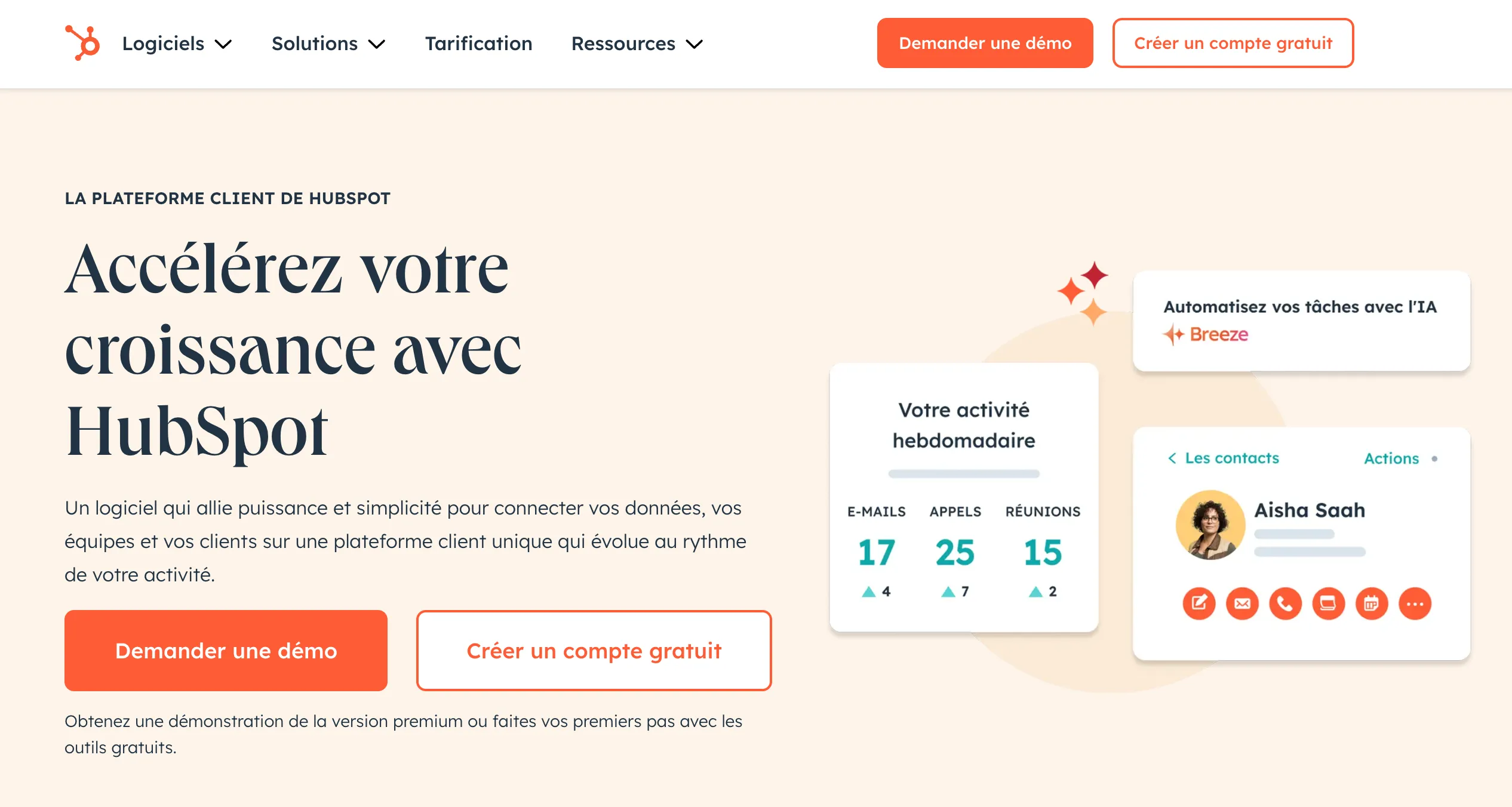
What is HubSpot?
HubSpot is a customer platform that brings marketing, sales and customer service together around a central CRM, the Smart CRM. In practice, it is where you store your contacts, companies, quotes and deals, where you send your prospecting emails or campaigns, and where you track your clients' requests. The platform is split into hubs (Marketing, Sales, Service, Content, Data, Revenue), completed by the Breeze AI tools, and it starts with free tools that are enough for many freelancers.
Who is HubSpot for?
Freelancers and solopreneurs who handle a real flow of leads: consultants, one-person agencies, trainers, independent sales reps. If you lose track of your follow-ups in your inbox, the free CRM puts everything back in order. On the other hand, if you just want a light list of leads, Folk or a Notion base will take less effort, and if your business relies on a strict sales pipeline, Pipedrive is more direct. HubSpot wins when you want marketing, sales and service in the same place.
What you can do with HubSpot
- Centralise your contacts: a unified view of each contact, with its companies, deals and conversation history.
- Track your pipeline: organise your opportunities by stage and track activities, from the free version.
- Handle client requests: incoming tickets are routed to the right person, and an AI agent can answer on every channel from the Pro plan.
- Prospect and follow up: targeted email campaigns, calls, AI recording and transcription of meetings, chat with your website visitors (Starter).
- Automate: simple automations and AI agents on Starter, advanced automations and AI-generated quotes on Pro.
- Connect your tools: 2,000+ integrations to keep your invoicing tool, calendar or inbox.
HubSpot pricing in 2026
- Free tools: €0, up to 2 users, no credit card. Contacts, companies, deals, activity tracking, tickets, app sync and the Breeze assistant.
- Starter: €7 per month per seat, on promotion (65% off, limited time, new customers only), up to 10 users. Email and chat support, AI-updated CRM, simple automations, email campaigns, calls, chat on your site. 5,000 HubSpot credits a month.
- Pro: €90 per month per seat. Advanced automations, social media, Marketing Studio, content agent, AI quotes, help desk. 10,000 credits a month. Additional seat: €90 a month.
- Enterprise: €175 per month per seat. Team organisation, sandbox, fine-grained permissions, multiple accounts, approvals. 15,000 credits a month. Additional seat: €175 a month.
Prices displayed with annual billing, before tax. Prices checked on hubspot.fr in November 2026.
Why we recommend HubSpot
At FreelanceKit, we picked HubSpot for a simple reason: its free CRM is one of the most complete a freelancer can use without taking out a credit card, and it does not stop after 14 days. Contacts, pipeline, tickets, integrations: enough to last months, even years, before needing to pay. And the day you grow, everything is already in the same place.
The weak point to know: the step between free and paid. Starter at €7 is a limited-time promotion, reserved for new customers and displayed with annual billing; above that, Pro jumps to €90 per month per seat, a price built for teams, not for one person. The interface is also dense: hubs, menus and features you will never open, and a few hours to plan before feeling at ease.
HubSpot or another solution?
If you are hesitating between Folk, Pipedrive or Notion, see our page on alternatives to HubSpot.
Strengths and weaknesses
Strengths
- Free tools with no credit card: contacts, companies, deals, tickets and the Breeze AI assistant, up to 2 users
- Marketing, sales, customer service and content on the same platform, with 2,000+ integrations
- Starter at €7 per month per seat on promotion, with email and chat support, simple automations and email campaigns
- Interface, pricing and support in French, with all your customer data centralised in the Smart CRM
Weaknesses
- The jump from Starter to Pro is steep: €90 per month per seat, and €175 on Enterprise
- The €7 Starter price is a limited-time promotion for new customers only, displayed with annual billing
- A platform built for teams: lots of hubs and menus a solo freelancer will never use
Frequently asked questions about HubSpot
HubSpot is a customer platform that unifies marketing, sales and customer service around a central CRM, the Smart CRM. It is made of several hubs (Marketing, Sales, Service, Content, Data, Revenue) and AI tools grouped under the name Breeze. More than 288,000 companies in more than 135 countries use it, and it starts with free tools.
The free tools are €0 up to 2 users, with no credit card. The Starter plan is displayed at €7 per month per seat (65% limited-time promotion, new customers only, up to 10 users). The Pro plan is €90 per month per seat, and the Enterprise plan €175 per month per seat; each additional seat costs the same. Paid plans include HubSpot credits: 5,000 a month on Starter, 10,000 on Pro, 15,000 on Enterprise. Prices checked on hubspot.fr in November 2026.
Yes. The free tools include a unified view of your contacts, company and deal management, activity tracking, routing of incoming tickets to the right team, sync with dozens of apps and the Breeze AI assistant, for up to 2 users and with no time limit.
To organise your leads, track a pipeline and keep each client's history, yes: the free tools are more than enough for one person. The trap is the upgrade path: as soon as you want advanced automations or full marketing, you move to Pro at €90 per month per seat, a price built for teams.
Credits included in each paid plan (5,000 a month on Starter, 10,000 on Pro, 15,000 on Enterprise), consumed by certain platform features, in particular the AI agents such as the customer support agent. Additional credits can be purchased.
If you just want a list of leads with follow-ups, Folk or a Notion base will take less effort. If your business relies on a structured sales pipeline, Pipedrive is more direct. HubSpot wins when you want CRM, marketing emails, forms and customer service in the same place, with room to grow.
Alternatives to HubSpot
What we would use instead, in the same category.





Compare all the alternatives to HubSpot
See our full comparison of the 3 alternatives to HubSpot in 2026: prices, features and strengths, in detail.
🚀See the full comparison